Case study2026
Lucky Wander Wyatt
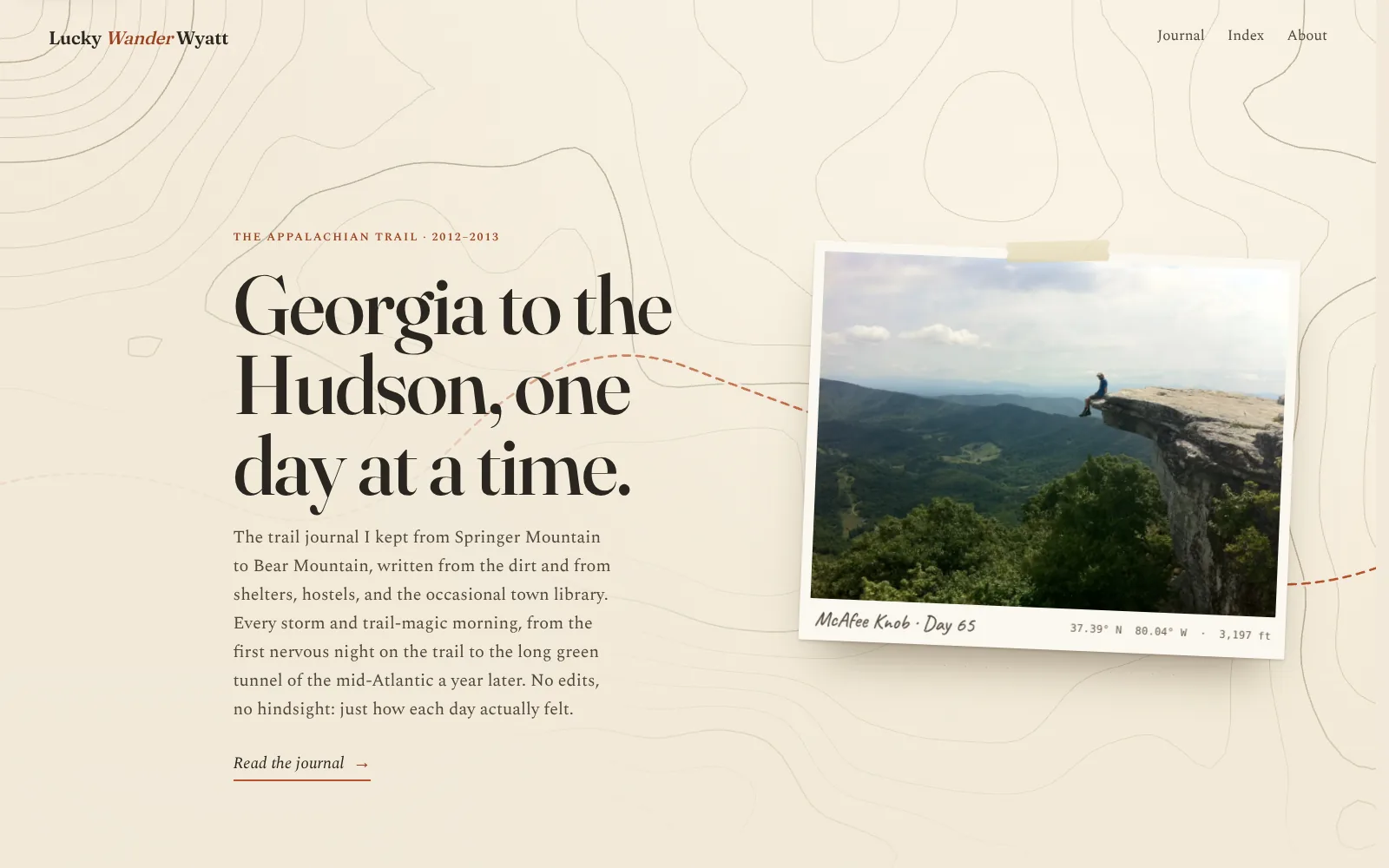
My Appalachian Trail journal from 2012–13, rebuilt as a 3D world you walk through: each entry at its place on the trail, in that day’s terrain, weather and sky, read aloud in my own voice.
- three.js
- WebGL
- React
- TypeScript
- Sound design
- Narration
- SEO
 Visit luckywanderwyatt.com (opens in a new tab)
- journal entries
- 114
- miles walked
- 1,353
- photographs
- 413
- read aloud
- 5.6 h
- Built
- 2026, from a blog kept in 2012–13
- Role
- Concept, design and direction; engineered with Claude Code
- Stack
- React, three.js, TypeScript, Vite, Cloudflare Pages
- Voice and sound
- ElevenLabs, from my own voice
Overview
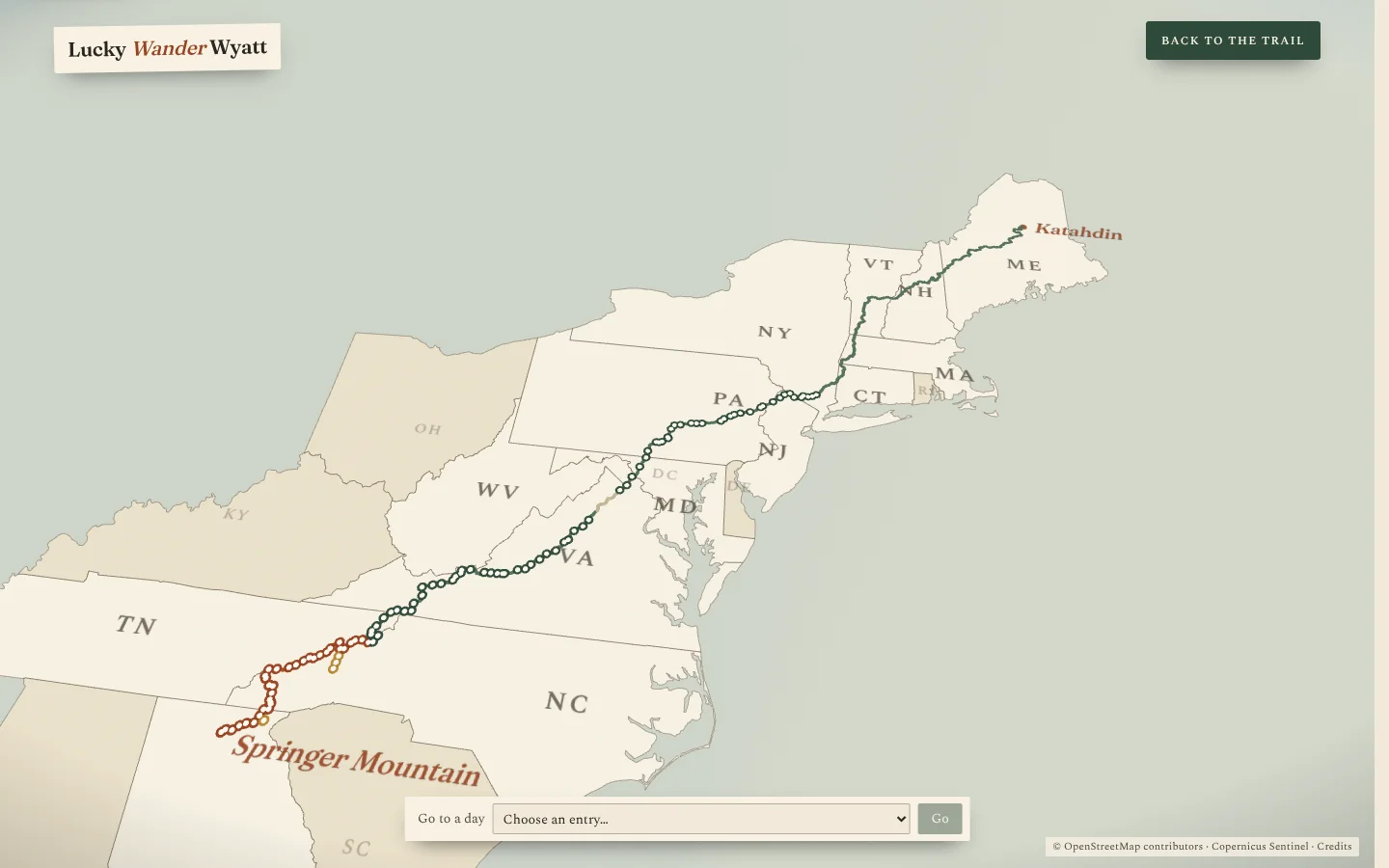
In 2012 I set out from Springer Mountain, Georgia, to walk the Appalachian Trail, and wrote about it as I went, from shelters, hostels and the occasional town library. A year later I went back and walked on to Bear Mountain, New York. The blog ended at 114 entries: about 60,000 words, 413 photos and 30 video clips.
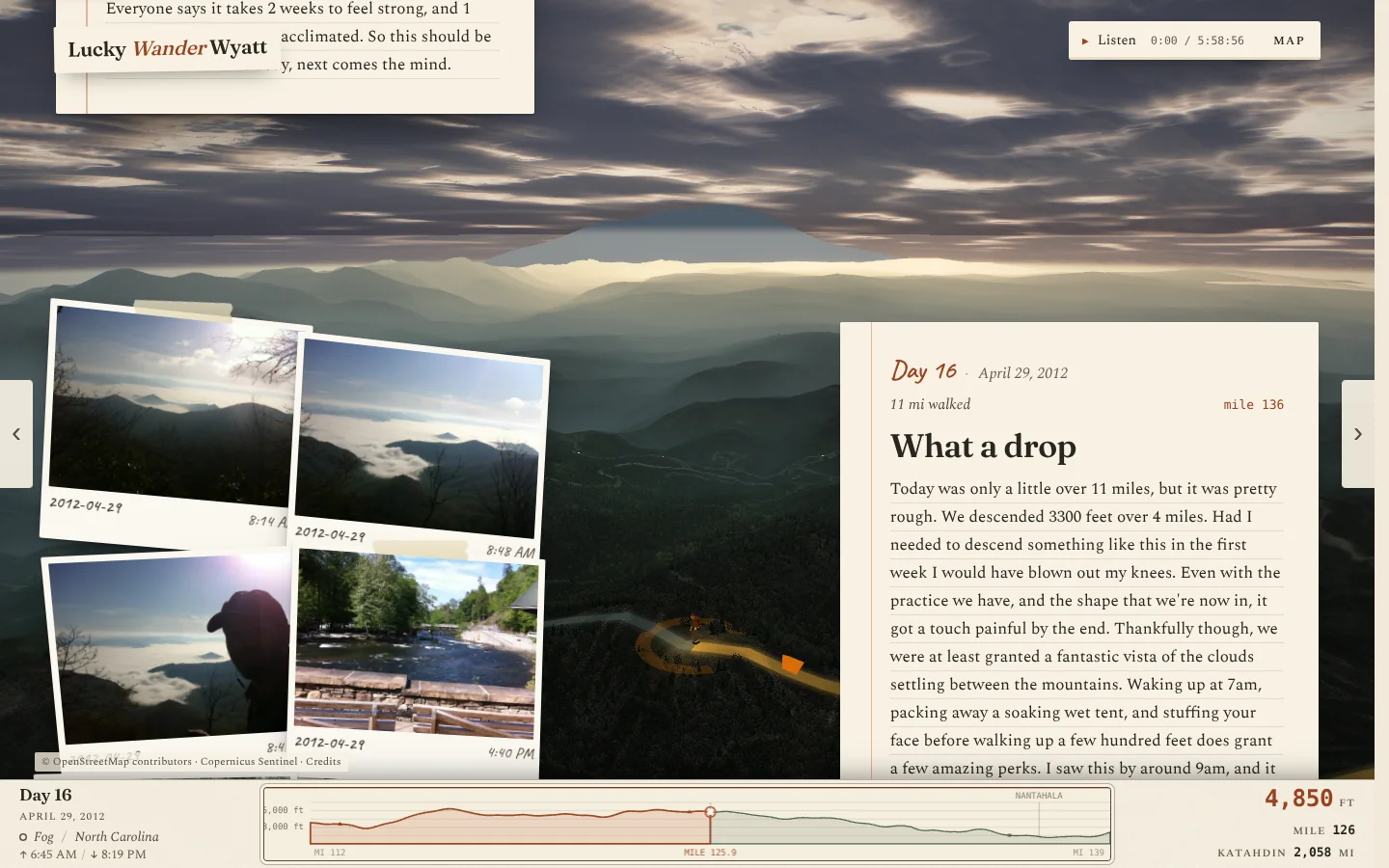
Rebuilding it, I wanted the reading to feel like the walking. On luckywanderwyatt.com, scrolling is the walk: the page moves along the real trail, mile by mile and hour by hour, and each entry is written over the place and the day it describes.
A journal you walk through
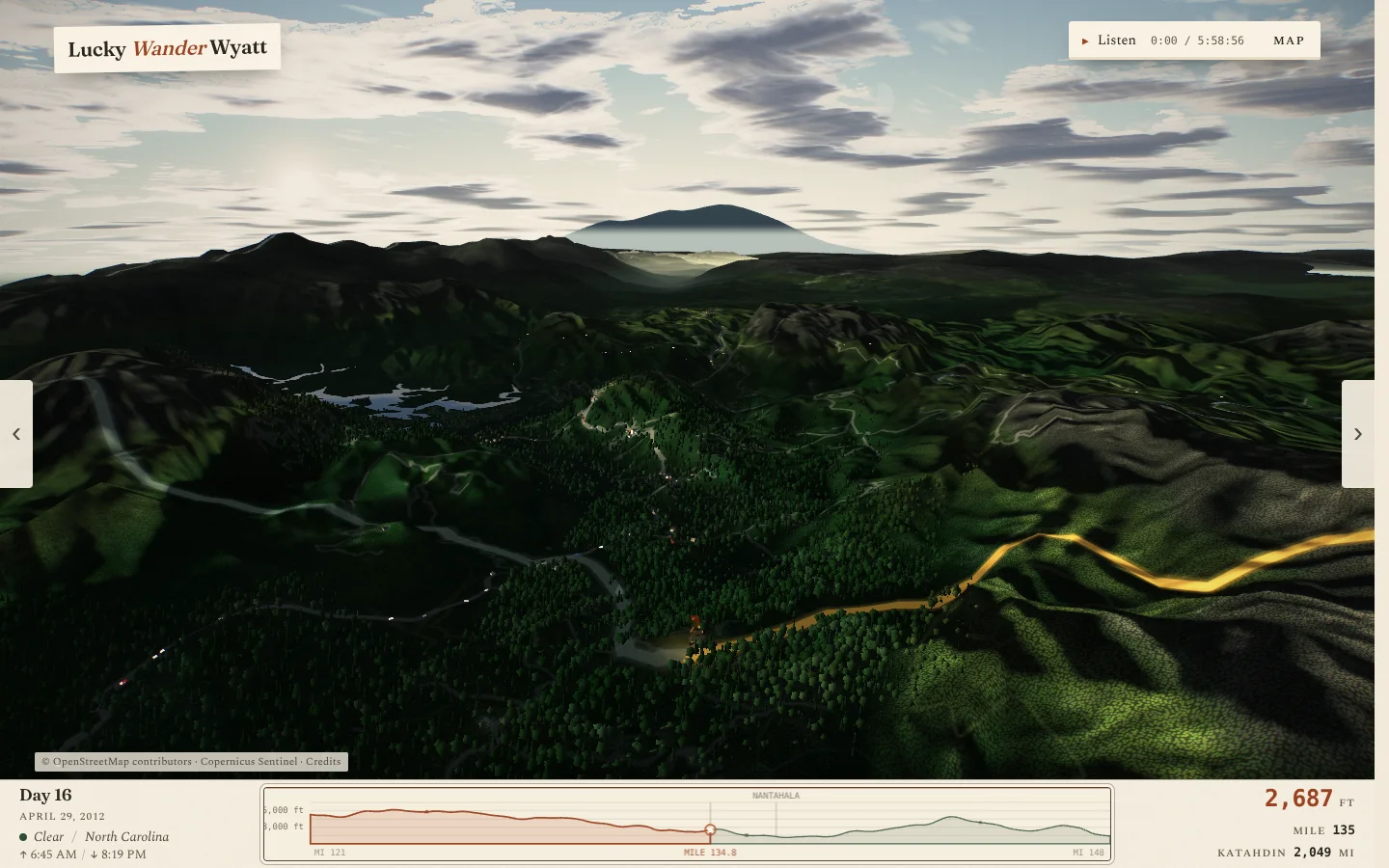
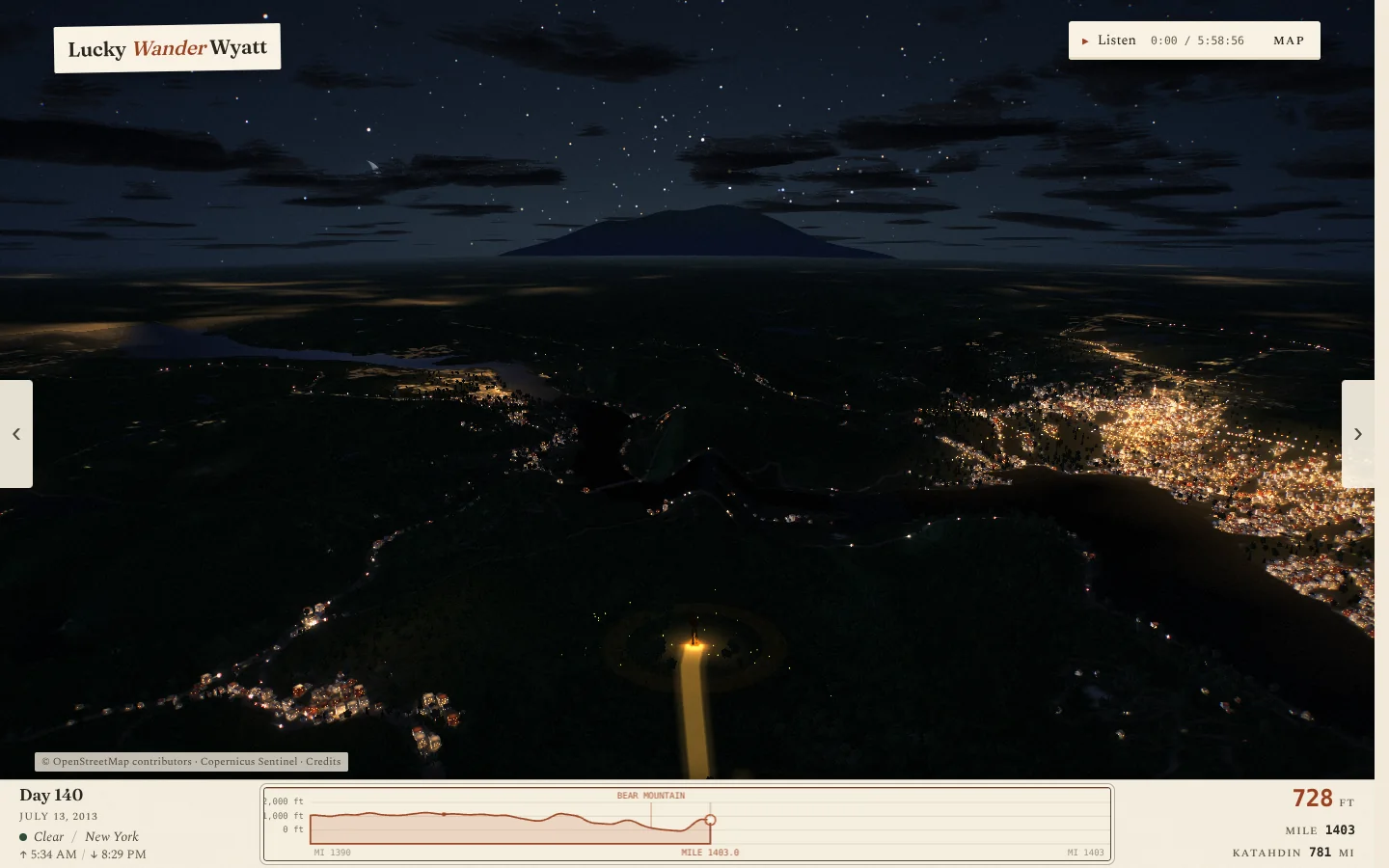
Every entry sits at the mile it was written at. As you read down an entry the day passes: the sun crosses the sky, evening comes on near its end, and the night falls before the next one. The ground is the real ground, built from USGS and Canadian elevation data under satellite imagery from Copernicus Sentinel-2, and trees stand wherever that imagery shows forest, in its colours, bare above the spring’s leaf-out line.
The weather is the real weather too. NOAA’s hourly station records drive the clouds, the wind, the fog and the rain on each day of the walk; rain falls on the wind and hazes the distance, lightning is drawn as real geometry, and lakes mirror the sky and the hills around them.
In my own voice
Every entry is read aloud, 5.6 hours in all, in a voice made with ElevenLabs from my own. Press Listen and the page walks at the pace of the reading, puts the text away, and brings up each photo beside the path as the words reach it. It carries on with the screen off, entry after entry, with the lock screen’s controls, and picks up where you stopped.
Underneath is the sound of the place, worked out from the same state as the picture: wind and rain at the day’s strength, birds, crickets in late summer, tree frogs on spring nights, traffic from the actual roads nearby, thunder arriving after each strike at the speed of sound, and footsteps on earth, mud or snow.
Fast on a phone
A world this size has to arrive quickly on a phone. The opening asks only for the data its first view reaches, about 5 MB, and fetches the rest nearest first once you are in. Every shader is compiled behind the loader, so nothing stutters after it, and the frame rate settles when nothing on screen is moving. The loading hiker is baked from the scene itself, so the hand-over to the 3D hiker can’t be seen.
The rest of the site is ordinary, quick HTML: its content pages score 99 to 100 for performance in Lighthouse on mobile.
Readable by anyone, and anything
Search engines and AI crawlers don’t run a 3D scene, so each entry is also its own page of plain HTML: its words, photos and facts, with structured data giving its date, place and coordinates. There is an RSS feed, a sitemap with every photo, and llms.txt. Without WebGL the journal opens as text, and it works by keyboard and screen reader throughout.
It is held to that by 31 browser checks: shaders that compile in time, layout that doesn’t shift, a Content-Security-Policy with no violations, pages that hydrate cleanly. A nightly run opens the live site as a reader would.
Outcome
What was a run of blog posts is now the walk itself, mile by mile, in the weather of the day, in my own voice. It’s the clearest thing I’ve made of what I care about most: the craft you notice only as a feeling, the detail under the surface that makes something feel real.
Visit luckywanderwyatt.com (opens in a new tab)Like what you see?